
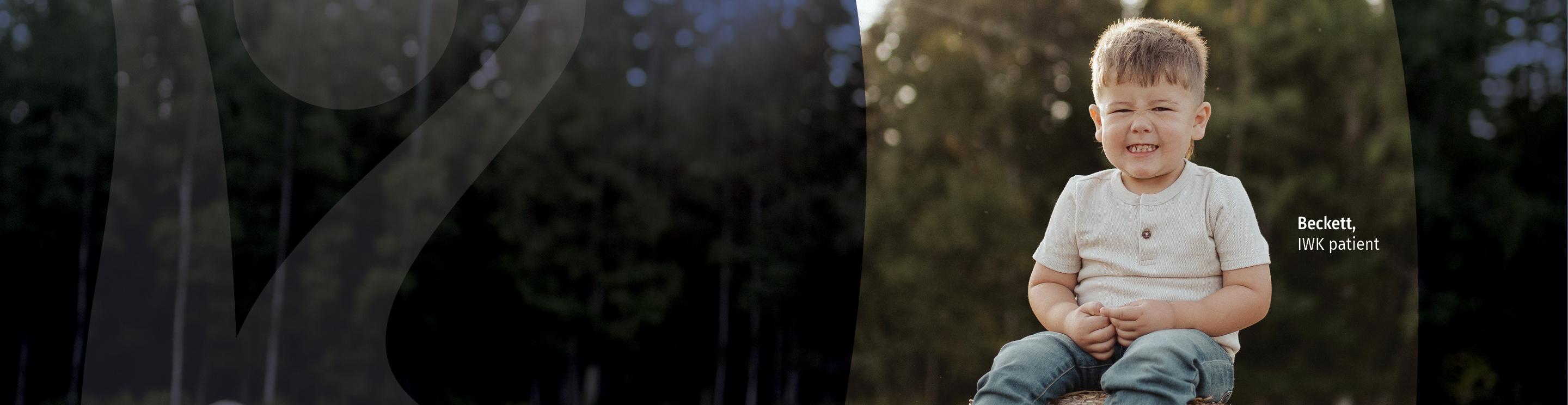
When Stephanie and Ashten’s newborn son, Beckett, was born with severely low blood sugar, they thought he could have diabetes because there was a family history. But after his care team in New Brunswick ruled out diabetes and other potential medical issues and couldn’t determine an official diagnosis, they realized Beckett needed the specialized care of the IWK.
In November 2022, Beckett was transferred and admitted to the IWK. He underwent a clinical exam and blood tests and was given a feeding tube to ensure he was getting proper nutrition to manage his blood sugar.
An IWK geneticist, who examined Beckett, noticed his liver was enlarged and suspected Beckett may have a rare metabolic disorder called Glycogen Storage Disease type 1a (GSD1a) due to also having severely low blood sugar. People with GSD1alack the enzyme needed to turn glycogen (the stored form of glucose) into glucose (sugar in your blood) in the liver. As a result, it can cause low blood sugar, liver inflammation, muscle pain, fatigue, and easy bruising.
Although there is no cure for GSD1a, treatment options such as cornstarch therapy can help with development and improve metabolic function. Because uncooked cornstarch is digested more slowly than most carbohydrates in food, it provides a longer-lasting source of glucose and helps maintain blood sugar levels for an extended period.
While the family waited for the genetic results to come back, Beckett's care team started him on a feeding pump with a formula mixture that stabilized his blood sugar. His family and care team were thrilled it made a positive impact on how he was feeling.
In December 2022, the genetic results confirmed what his IWK care team long suspected—Beckett has GSD1a.
“We were really scared because we didn't really know what life would look like,” shared Stephanie on learning Beckett had a rare condition. “It was hard, but we trust the IWK. They saved our son’s life, and their support doesn’t end when you walk out the door.”
To manage Beckett’s lifelong condition, he must take an uncooked cornstarch mixture every 2-3 hours during the daytime. Before bed, Beckett takes Glycosade, a long-acting starch used for the dietary management of GSD1a, which eliminates the need to feed him the uncooked cornstarch mixture every 2-3 hours overnight. The body breaks it down slowly, which helps keep blood sugar levels within the normal range.
Before starting Glycosade in 2025, Stephanie and Ashten needed to give Beckett his cornstarch feeds every 2-3 hours throughout the night. “It was not sustainable,” shared Stephanie.
Beckett, who will turn four in August, is doing great. “He’s full of energy. He’s super silly, and he loves all things sports and superheroes,” shared Stephanie.
Stephanie and Ashten are deeply grateful for the care and support they and Beckett have received from the IWK. “We love the IWK and how much they've helped us navigate this condition,” said Stephanie. “We’ve been able to move through my son's diagnosis the way we have because of the support we have received.”

