
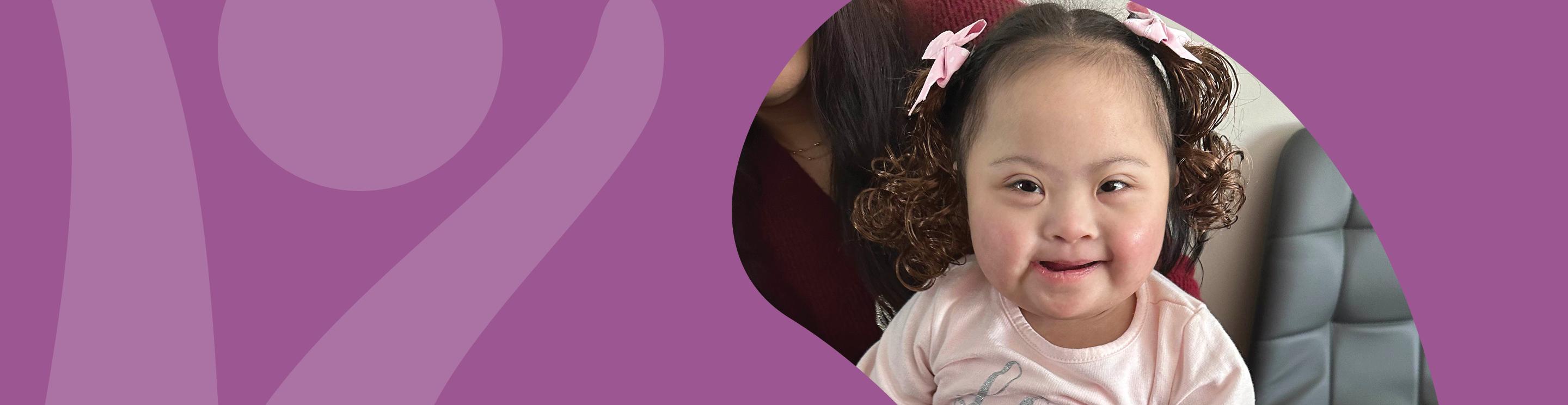
In 2023, Brigitte and Christopher were settling into their life together in New Brunswick with their two daughters, Jeanne and Jhanna, after moving from the Philippines to Canada.
Christopher arrived in Canada in 2019, and after four long years apart, the family was happy to be together again. When they envisioned their new life together in Canada, they never imagined that the IWK would become an important part of it.
In early 2024, when Brigitte and Christopher found out they were expecting their third child, they looked forward to their 20-week ultrasound where they would learn the sex of their baby and get the good news every expectant parent wants to hear – that the baby looks healthy.
With two healthy daughters at home, Brigitte and Christopher had every reason to believe their third child would be healthy as well. So, they were shocked to learn that their unborn baby, a girl, would be born with Down Syndrome, a common genetic condition caused by having an extra copy of chromosome 21.
People with Down Syndrome have distinct physical characteristics, like short stature, as well as intellectual and developmental delays. Congenital heart defects, respiratory infections, and gastrointestinal symptoms are among several medical complications often associated with the condition.
During this appointment, Brigitte and Christopher also learned their baby had a heart defect called Atrioventricular Septal Defect (AVSD). An AVSD affects the valves and walls between the heart's upper and lower chambers. It affects blood flow through the heart valves, causing the heart to work harder than it should.
They were told their baby would require specialized care at the IWK shortly after she was born to repair her AVSD. Brigitte's doctor in New Brunswick then referred her to the IWK for further evaluation and care.
At the IWK, Brigitte and Christopher received guidance and information to navigate the remainder of the pregnancy and learned what the next steps in their baby's IWK journey would be after her birth.
In September 2024, Brigitte and Christopher welcomed baby Juliana at their local hospital in Moncton, New Brunswick. She was small, weighing just 5 pounds.
Juliana was fitted with a feeding tube through her nose to provide her with proper nutrition she couldn't get orally. Symptoms associated with AVSD and other congenital heart defects often make oral feeding intolerable.
When Juliana was three months old, she visited the IWK's Children's Heart Centre. Here, her care team determined that to repair her heart safely, Juliana would need to gain weight. Her small body wasn't quite strong enough to undergo heart surgery.
Fortunately, Juliana reached a safe weight when she was six months old. In February 2025, Juliana underwent a successful AVSD repair.
Watching Juliana face a life-threatening condition was terrifying for her family. While they were in disbelief that this was part of Juliana's story, they trusted her IWK care team to save her life. "We had faith in the IWK, knowing that they are the best doctors," shared Christopher.
While Juliana was recovering from surgery, her care team discovered she had Pulmonary Hypertension (abnormally high blood pressure in your lungs). She also had a blood infection.
For nearly three months, Juliana received in-patient care in both the IWK's Pediatric Intensive Care Unit (PICU) and the Neonatal Intensive Care Unit (NICU) as her care team navigated the complications of her recovery.
This long stay at the IWK was challenging for the family. Christopher continued working and caring for their daughters at home in New Brunswick, while Brigitte stayed full-time at the IWK with Juliana.
Finally, Juliana was discharged from the IWK in April 2025.
At home, Juliana required frequent checkups. Fortunately, the IWK's Travelling Clinic allowed the family to take Juliana for a checkup with a cardiologist in New Brunswick, saving them the long trip to Halifax.
In November 2025, Juliana underwent one last surgery to insert a different type of feeding tube called a GJ tube, a flexible tube that is inserted into the stomach. With this, Juliana could grow and play without the risk of accidentally pulling the tube out of her nose.
Today, Juliana's development is tracked closely by her IWK care teams. They frequently check her head, watching for signs of Hydrocephalus, an abnormal buildup of cerebrospinal fluid (CSF) on the brain which has uncomfortable and often dangerous symptoms.
Now almost two years old, Brigitte and Christopher say Juliana is doing very well, "She's a happy baby. She's smart, and she's doing things we didn't know if she would do, like laughing."
With the support of the IWK, Juliana has the best chance for a bright future. Her parents are grateful for the care of the IWK. "The IWK has all the specialists, the very best doctors and nurses. We're thankful to have the IWK in the Maritimes. They saved Juliana."
As a Dairy Queen team member, Christopher finds meaning in his work knowing he and his colleagues help make a difference for IWK patients and families across the Maritimes. As a Children's Miracle Network (CMN) partner, Dairy Queen raises funds for children's hospital foundations across Canada and the United States.
In Canada, Dairy Queen supports 13 children's hospitals through Canada's Children's Hospital Foundations (CCHF). Every dollar raised locally stays locally – including in the Maritimes, where funds raised support the IWK.

