
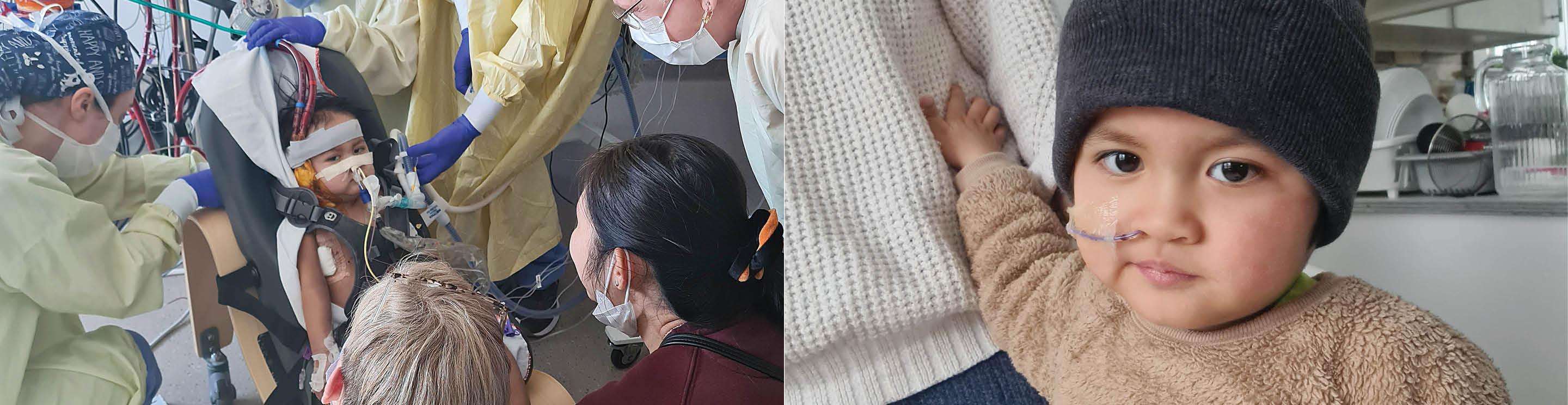
In February 2025, Bao and Oanh believed their 1.5-year-old son, Johnny was battling a common flu. But when days passed and his symptoms worsened instead of improving, concern quickly turned into urgency. They had no idea that this was the first step in a long and unexpected journey that would soon require highly specialized equipment not available at every health centre. Fortunately, that specialized care was available at the IWK.
At their local hospital’s emergency department, Johnny was diagnosed with Influenza B, a highly contagious viral infection. The doctors recommended he rest at home as he completed an antibiotic treatment that he was previously prescribed.
Unfortunately, Johnny’s condition worsened. With extreme fatigue and difficulty breathing, his parents knew he needed urgent medical intervention, so they brought him back to the Emergency Department.
At the hospital, Johnny was in a critical state, unable to breathe and suffering from a high fever. Emergency doctors immediately punctured his chest and drained the excess fluid around his lung, administered IV’s and an oxygen mask. Bao and Oanh were terrified as they watched their little boy fight for his life.
An X-ray of his chest revealed one collapsed lung and the other infected with pneumonia (a lung infection). Staff arranged an EHS LifeFlight to the IWK because Johnny needed specialized care.
As Johnny was airlifted to the IWK, his parents drove there to meet him. The drive felt never-ending as they longed to be by their baby’s side. “It’s difficult to express how my wife and I felt,” Bao shares. “We were extremely worried about our son. We were in shock about the situation, and didn’t know what to say, so the drive was silent. All I could do was focus on getting us there safely.”
Doctors at the IWK discovered he contracted MRSA, a type of bacteria resistant to most antibiotics. That’s why MRSA infections are hard to treat because very few antibiotics are effective against them.
Unfortunately, in the following days, Johnny’s condition worsened. He was not receiving enough oxygen to his lungs. Doctors needed to intubate him, insert a feeding tube, and connect him to an ECMO machine, a form of life support that temporarily takes over the work of the lungs and heart. Currently, the IWK is the only hospital in the region with an ECMO machine.
Learning that Johnny could have died without this advanced care was inconceivable to Bao and Oanh. “We couldn’t believe the situation was so bad,” Bao shared, remembering this frightening moment. Counselors offered support to Bao and Oanh through this difficult time.
For 20 days, Johnny was in a medically induced coma. He was monitored around the clock, and his parents never left his side. Though Johnny could not respond, his parents would speak to him and play music and movies they knew he enjoyed. When Johnny finally woke, he remained on ECMO for another 16 days as doctors flushed fluids from his lungs. In late March, they observed improvement in lung activity, and his lungs were almost clear of infection.
To ensure air could reach Johnny’s lungs more easily, he underwent a tracheotomy, a surgical procedure to create an opening in the neck into the windpipe for breathing.
The road to recovery was steep. Johnny’s muscles had lost their strength from weeks of immobility, his lungs still fragile. But with the help of the incredible IWK rehabilitation team and his parents, he slowly regained his muscle strength.
Day by day, his health improved. He started breathing on his own, and his lungs were strong enough to be off ventilation during the night. Then they removed his tracheal tube. Johnny slowly regained his mobility and the day they had all been waiting for was finally here. After spending 102 days at the IWK, Johnny was finally discharged and was able to return home with his parents to reunite with his sisters.
Today, Johnny is showing much progress with his rehabilitation and continues to gain his strength back. During his regular check-ups at the IWK, his care team is always excited to see how far he’s come.

